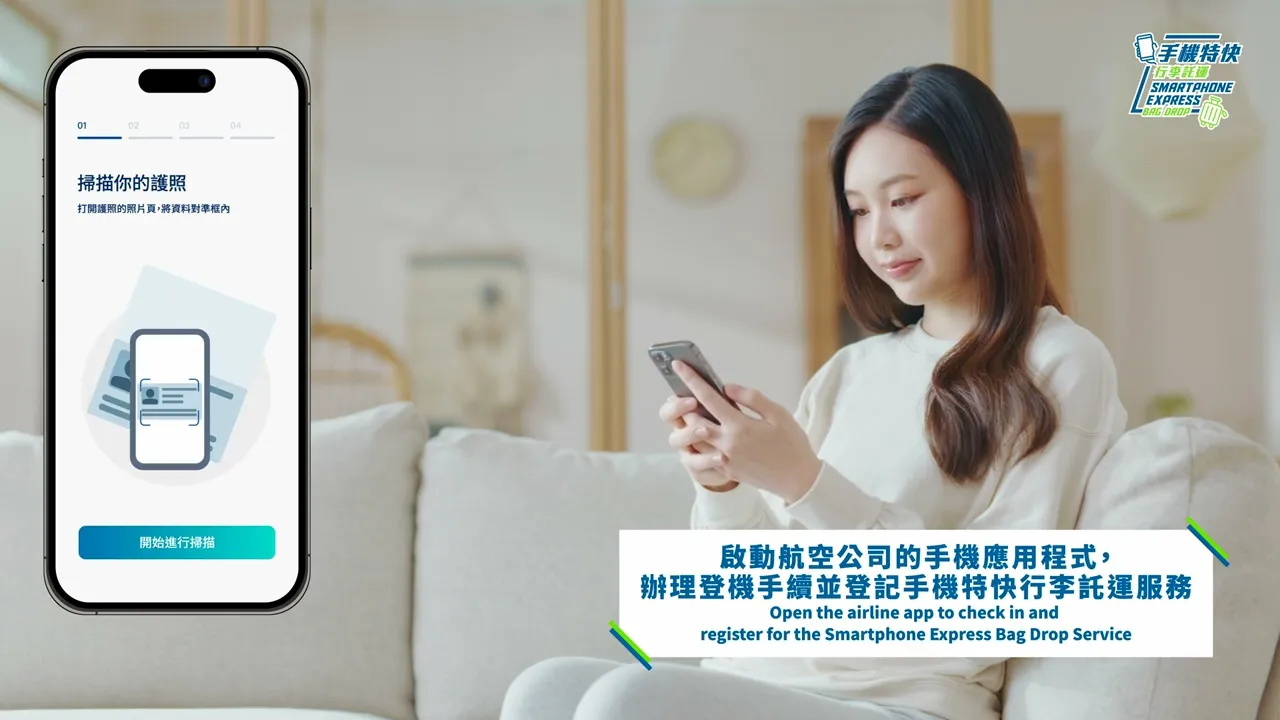
World's first large scale reusable identity for contactless travel at Hong Kong Airport following IATA’s One ID standards
Context
Hong Kong Airport launched the world’s first Smartphone Express Bag Drop that enables passengers to complete all departure procedures before they arrive at the airport. At the day of departure they can use their face to drop their bags and pass through various checkpoints.
The problem
The identified pain point is that passengers need to scan their travel documents each time they fly. That is because the airport is required to delete all passenger sensitive information after their flight to comply with data protection regulations.
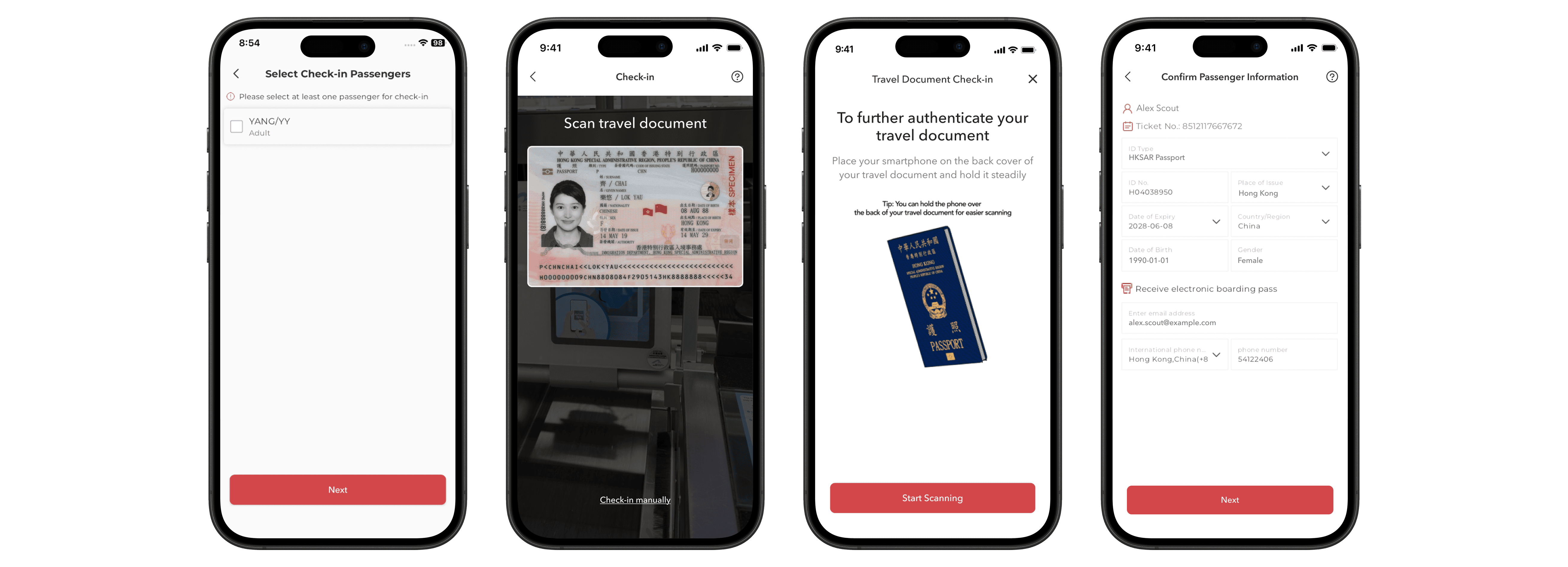
Before: check-in process to enable Smartphone Express Bag Drop
The solution
Reusable identity with decentralized identity wallets
Decentralized identity wallets solve the data storage problem by flipping the data ownership model. Instead of the airport holding passenger data, individuals securely store their information on their devices and share it at will.
When a passenger taps to use their travel document in the airline app, a deep link opens their digital wallet to initiate a presentation request. The wallet then returns the requested information only after the passenger has consented to share it.
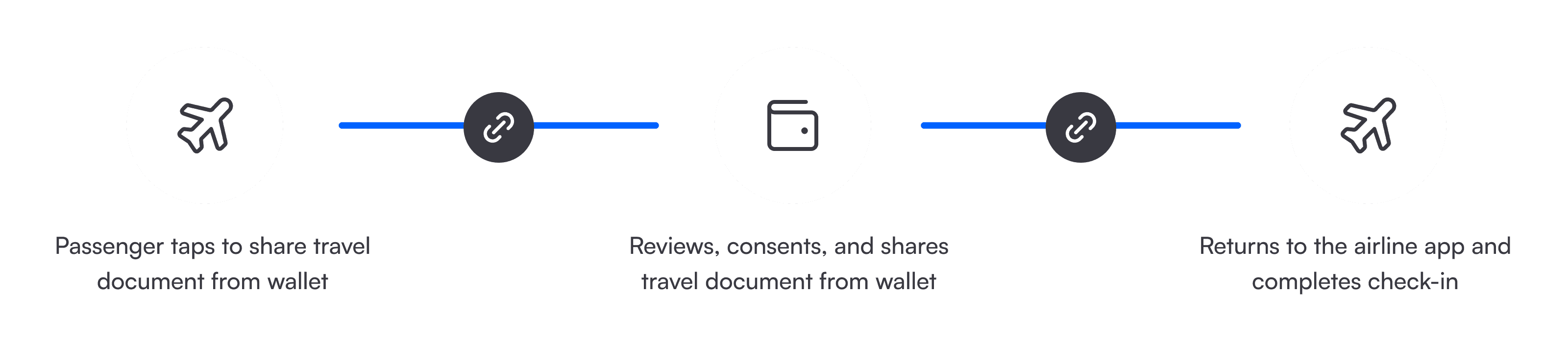
High level interaction of how identity wallets work
My role
Solo designer, end to end
I owned the end-to-end experience in a cross-company collaboration between Neoke, Hong Kong Airport, NEC, and Hong Kong Airlines. I adapted the Neoke wallet to the airport app experience, reskinned it to match the the airport app brand, and designed the travel document sharing flow between the airline and the airport app.p
The solution
Constraints
Limited access to passenger data and analytics.
One two-week usability test window.
No design system or Figma files for the airport and airline app.
No production reference. Most identity wallets globally are still in pilot. No airport has shipped reusable identity at this scale.
Research
Desk research and findings from interviews with stakeholders.
↳
Nearly 50% of Hong Kong passengers take three or more outbound holidays per year.
↳
Nearly 80% of Hong Kong passengers use their smartphone to check-in and navigate airport processes.
↳
Due to the city's dual status, passengers use specific travel documents depending on their destination and citizenship status.
↳
Globally the most frequent users of biometrics, though 80% of passengers express concern over how their biometric data is stored.
In app micro survey
With the help of the engineering team of the airline app, I ran an abandonment micro-survey with 200 participants to understand the KYC drop-off.
60%
I didn't have my physical documents with me.
37%
I didn't manage to scan my travel document.
3%
I felt uncomfortable sharing my travel document data.
Synthesis
These principles served as decision-making helpers during the design process.
Lead with efficiency, not data privacy
3% of surveyed passengers felt uncomfortable sharing travel document data. Most dropped off because they didn't have their document handy or couldn't complete the scan.
Make consent feel like a step of the process
In the decentralized identity world, data sharing needs user consent. In this use case, consent should feel like a natural part of the process.
Make the underlying tech invisible
All decentralized identity tech should be behind the scenes. Passengers care about reaching their destination faster, not where their data is stored.
Design
Airline check-in using the wallet
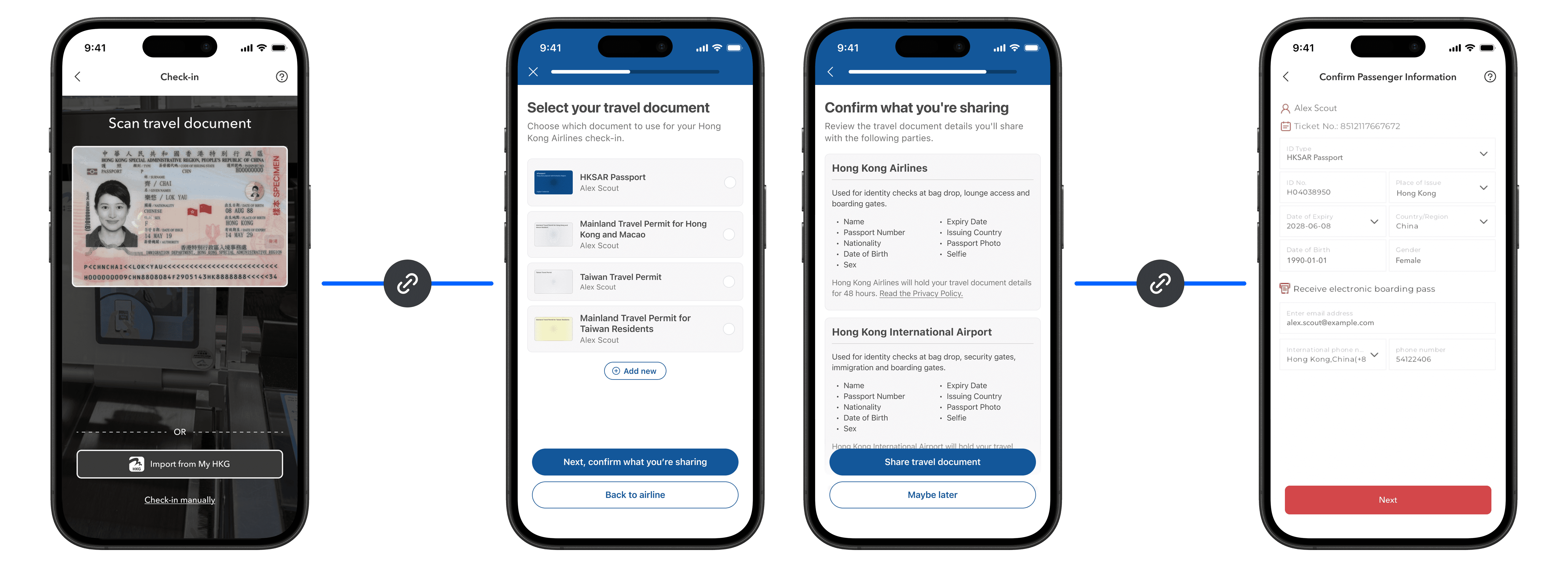
Digital wallet installed on passenger's device.
Success criteria
Metrics mapped to the passenger journey
Defined collaboratively with the teams.
Design
Add travel document
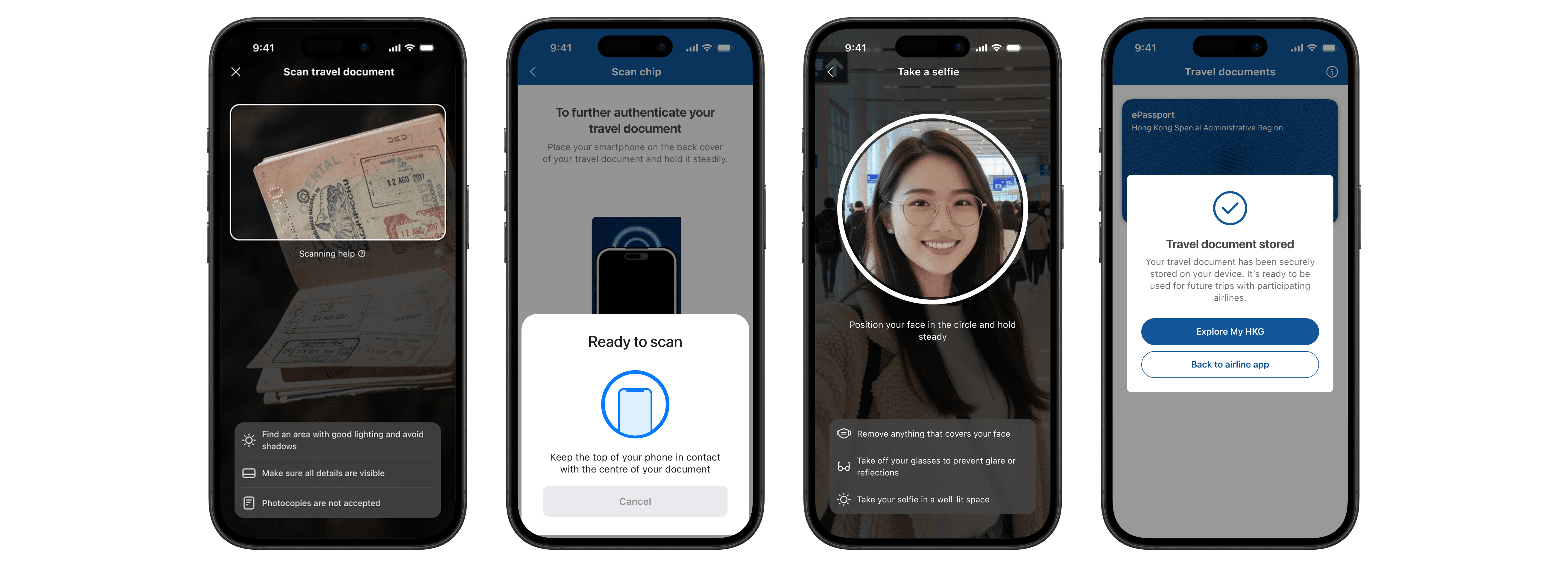
Onboarding
Digital wallets act as a secure, decentralized vault for travelers' official documents. By storing tamper-proof Verifiable Credentials locally on their smartphone, they can navigate airport checkpoints using biometric authentication as a unique, secure identifier. Unlike traditional systems that rely on centralized databases, this model ensures that travel documents remain under the traveler’s control, reducing the risk of data breaches and streamlining the boarding process.
For the Hong Kong Airport implementation, the high level flow is presented below.
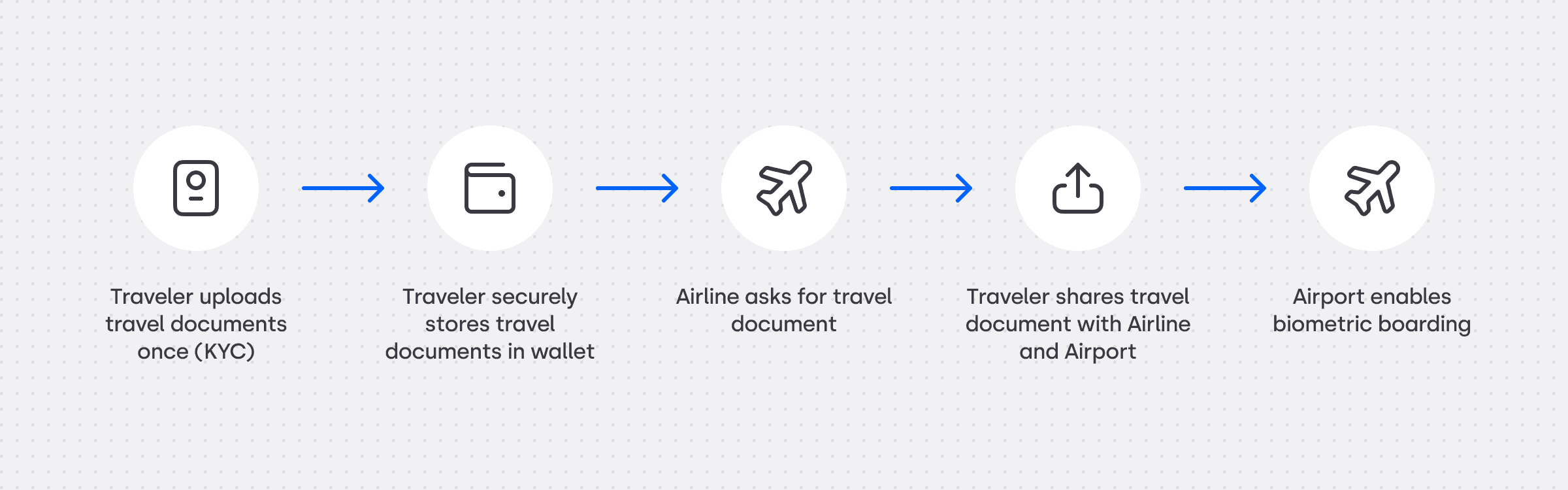
High level flow of document sharing to enable biometric boarding
The connection between the requesting service and the digital wallet is established via QR codes for web interfaces or deeplinks for mobile applications. In this implementation, the airline app initiates a request to share or save a document, triggering a deeplink that opens the digital wallet with an encrypted request. Once the traveler authorizes the transaction, a second deeplink facilitates a seamless app switch back to the airline app to finalize the journey.
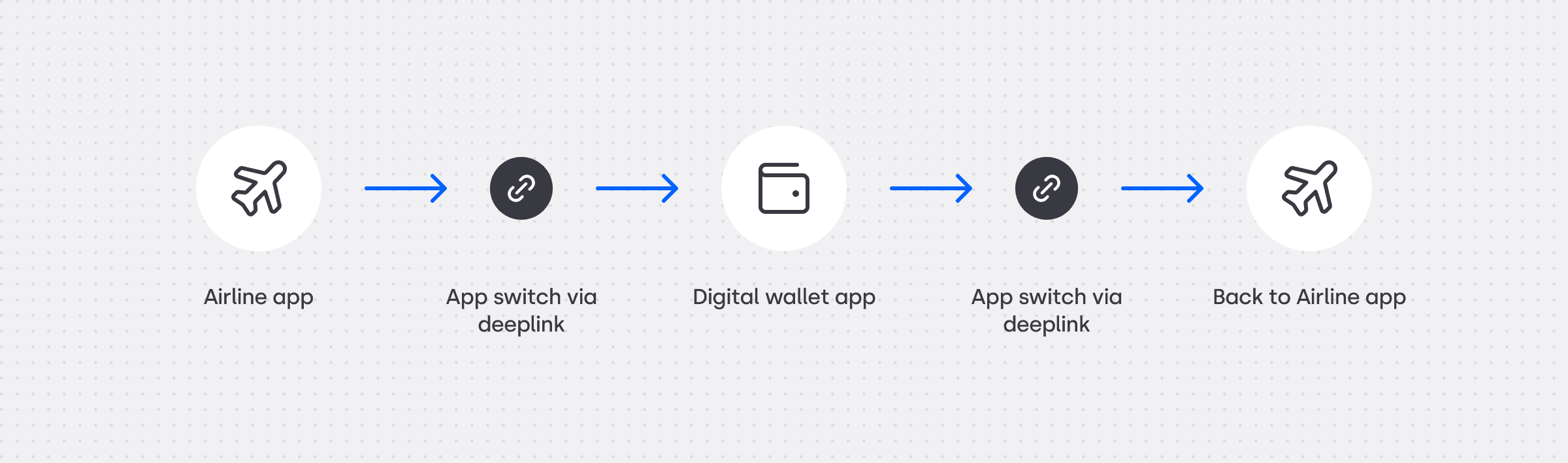
Document sharing via deeplinks
Deliverables
Standalone wallet app for testing based on the Neoke wallet
SDK with pre-built user interface, to be integrated in the myHKG app
Design adaptations to participating Airlines mobile app (Hong Kong Airlines, Hong Kong Express, Cathay Pacific)
Targets
Reduce bag drop speed from ~3mins to <1min
Increase biometric identification of departing passengers by 3% in 2026
Success metrics for Neoke
No of wallets activated
No of active wallets per year (wallet used at least once per year)
Core experience of the Neoke digital wallet
The existing Neoke digital wallet has been the basis of our discussion with the Hong Kong Airport team. Below is the core experience.
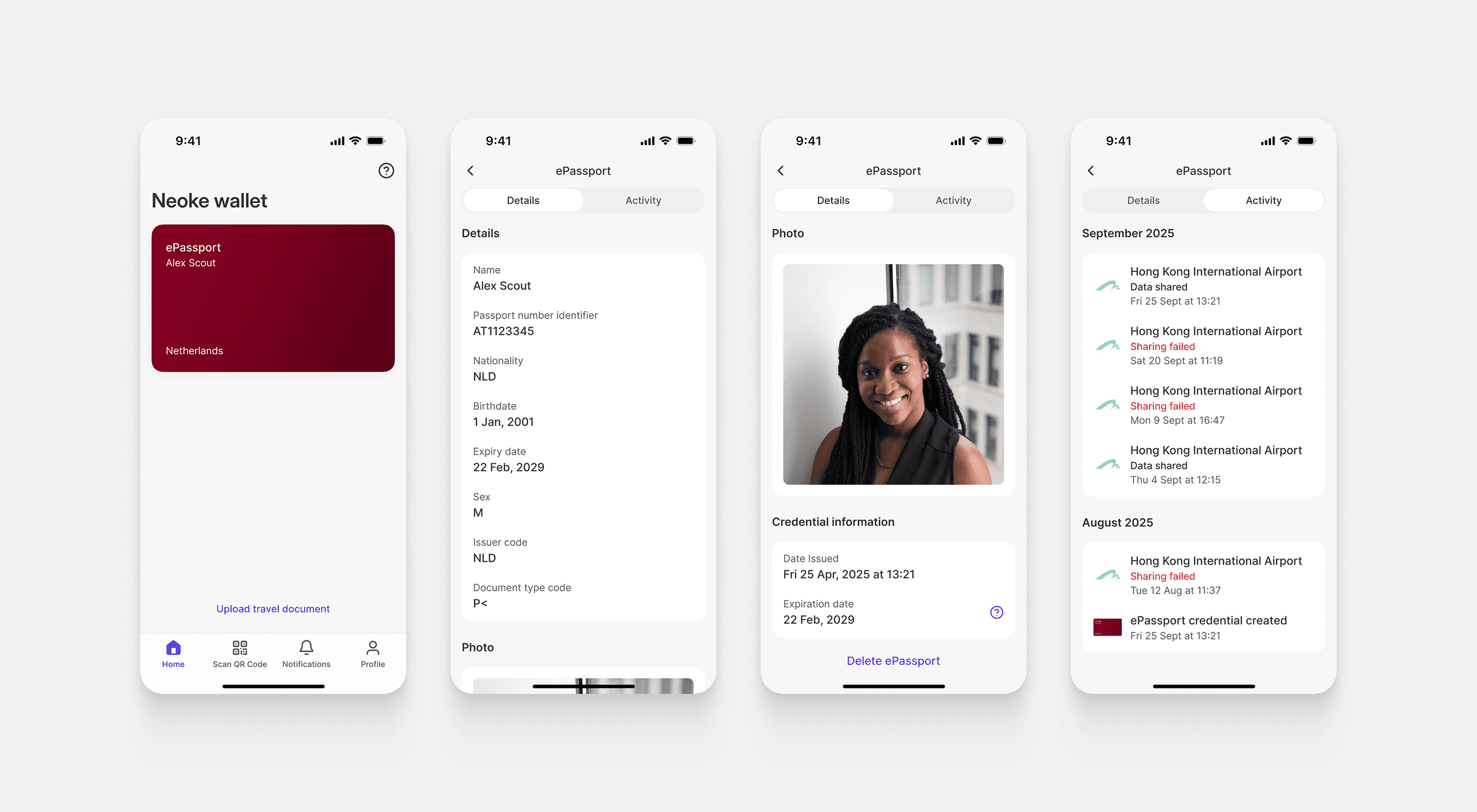
Travel document details and sharing activity
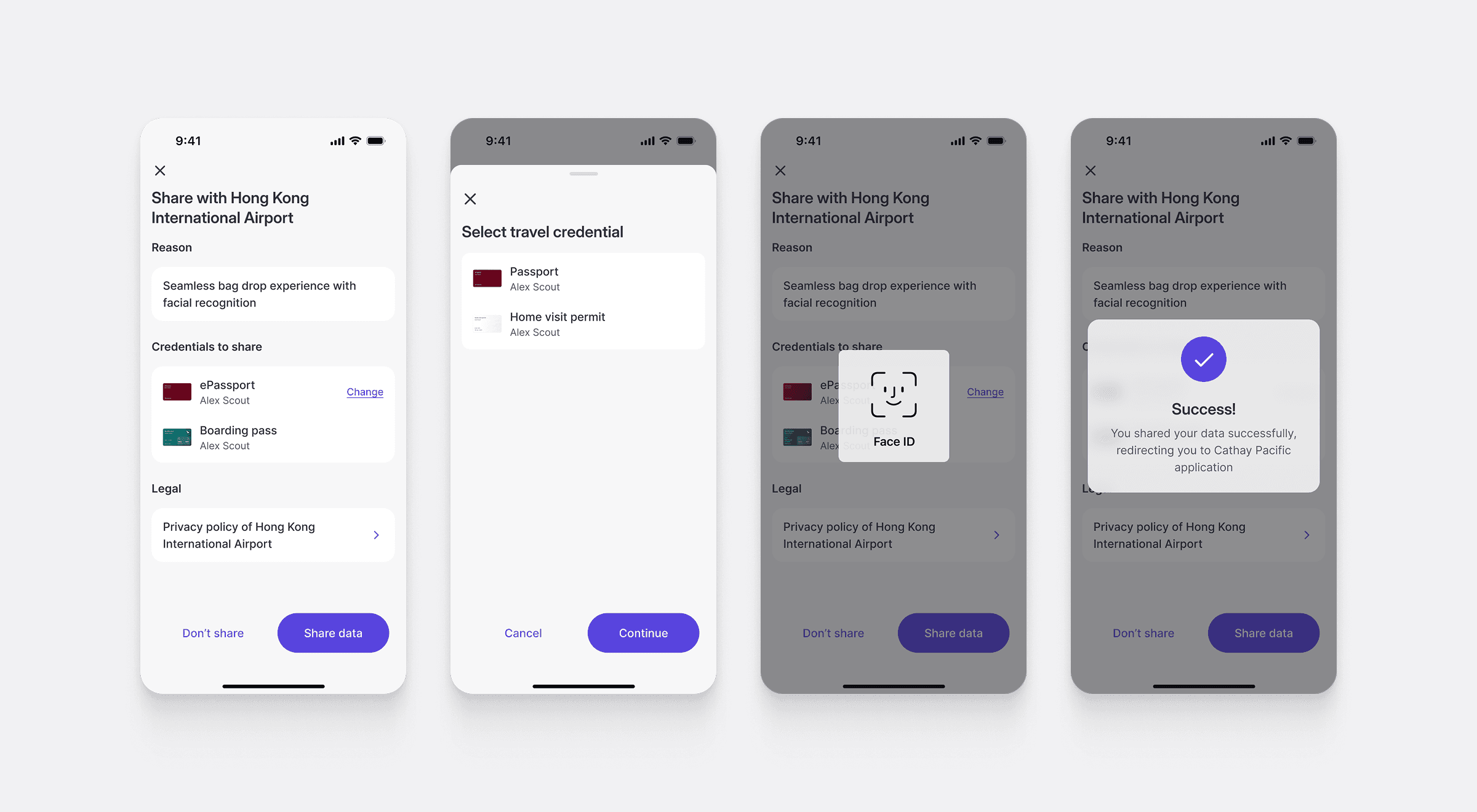
Share travel documents
Role
I lead Design, Product and stakeholder management to execute the project end to end. The Neoke team consisted of Estrella (CTO) and Nijat (mobile dev).
Other teams involved
Hong Kong Airport (Airport Authority, Infra, Security, Mobile app)
NEC (Digital Identity Team, Identity Verification Team)
Accenture (Hong Kong Airport contractor)
User flows
The expected main entry point is not the Hong Kong Airport wallet, but the participating airlines. Participating airlines for now are the ones native to Hong Kong, in particular Hong Kong Air, Hong Kong Express and Cathay Pacific. Part of the project has been to integrate with them. Here is the full flow of the check-in experience. Main flows
User has the Hong Kong Airport app installed and have already uploaded their travel document
User has the Hong Kong Airport app installed, but have no uploaded travel documents. They'll be asked to import
User hasn't installed the Hong Ko
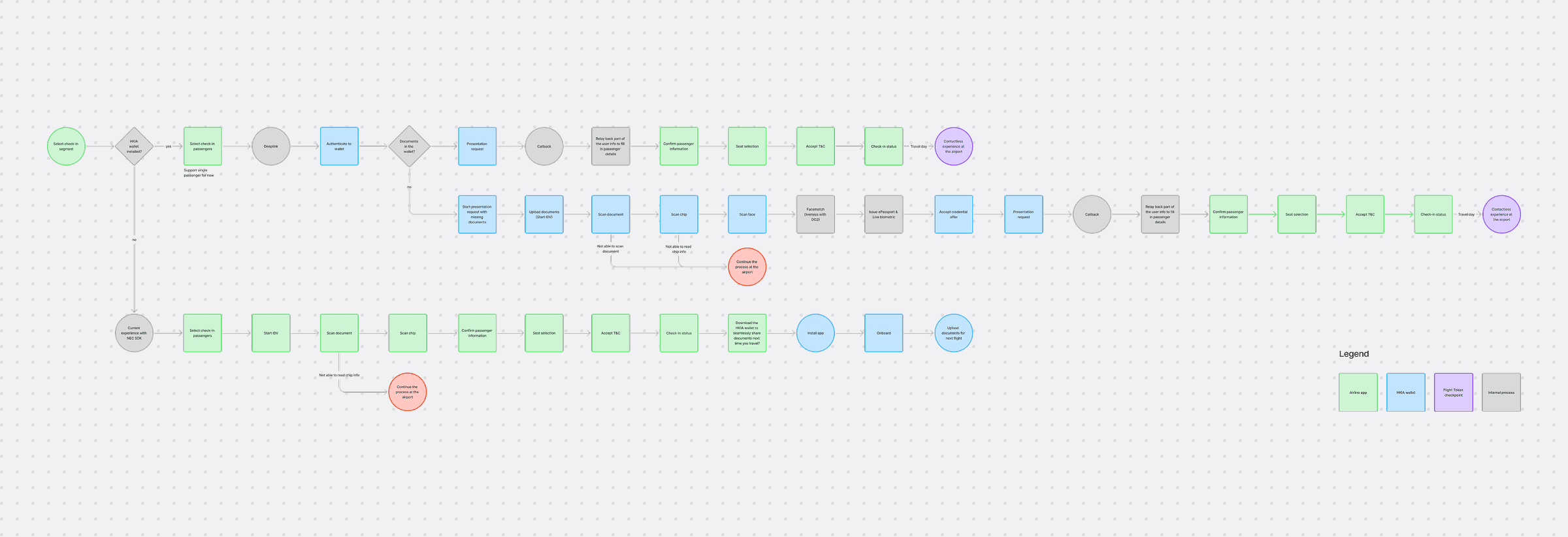
Add travel document from within the digital wallet
Internal testing and feedback
The existing Neoke digital wallet has been the basis of our discussion with the Hong Kong Airport team. They have been familiar with the experience in our collaboration for the IATA POC the previous year.
Caption